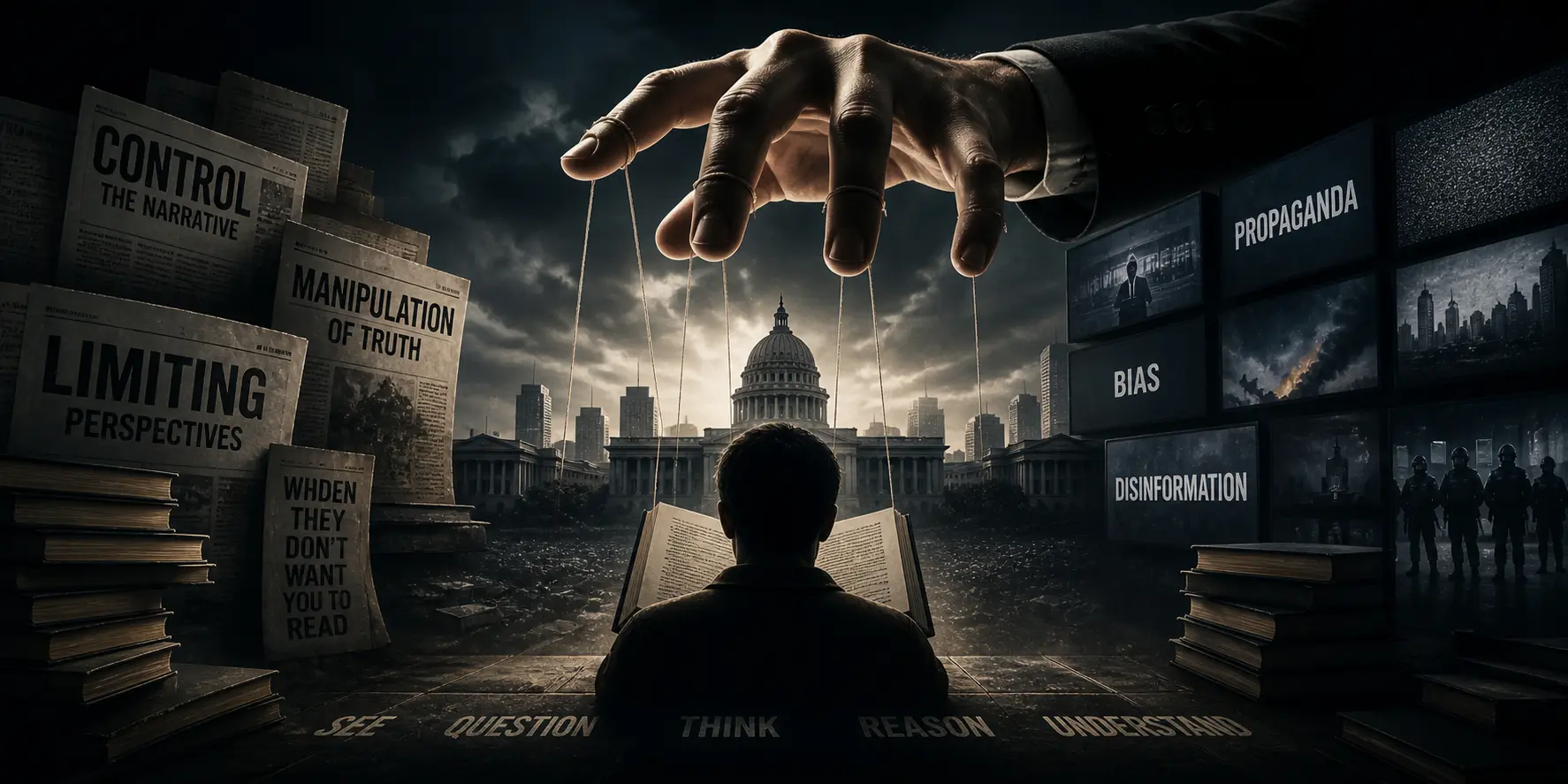
Governments don’t control what people read just to censor dissent. Believing so would be reductionist because, at its core, control over reading is about something far more important and fundamental: the express management of reality itself.
Simply put, what people read directly shapes what they know. What they know shapes what they believe. And what they believe will ultimately define what they are willing to accept, resist, or demand. For any state, this chain reaction is far too powerful to leave entirely unregulated.
[dt_sc_blockquote]
What people read directly shapes what they know. What they know shapes what they believe. And what they believe will ultimately define what they are willing to accept, resist, or demand.
[/dt_sc_blockquote]
<h3>1. To Stabilize the Political Order</h3>
The most immediate reason that governments control reading is to maintain political stability.
In China, this logic is the most explicit. The complete absence of open discussion around events like the Tiananmen Square protests in 1989 is not mere coincidence; rather it reflects a deliberate choice to prevent the emergence of any narratives that could challenge the legitimacy of the state. When certain parts of history are not widely read or discussed, they cannot become focal points for a collective questioning of the government.
From the state’s perspective, this is simply pre-emption of the public’s actions, because political instability begins with interpretation, rather than direct action. By shaping what citizens read, governments can shape how they interpret both past and present events, reducing the likelihood of dissent.
<h3>2. To Construct a National Identity</h3>
Beyond stability, governments can also control reading to define who their “we” is.
In India, this is visible in the ongoing changes of school curriculums and history textbooks; the intentional erosion of Mughal, Muslim history in ancient India. These are direct interventions by the state into the narrative of India itself. Which people are emphasized in history, which events are talked about more, and how these are interpreted all contribute to a collective sense of identity for India’s citizens.
Having studied in India, what stands out to me is not that information can be restricted outright, but rather that it is reframed. Different political moments are written to produce different emphases. The past ends up being reorganized for the benefit of the government’s idea of the ideal sense of identity for the nation.
<h3>3. To Set the Boundaries of Acceptable Thought</h3>
Control over reading also defines what can be thought by citizens, not just what can be said.
In China, this operates through some very clear boundaries. Certain topics are simply seen to be absent from mainstream platforms, which, over time, shapes the limits of public imagination. When these ideas are not encountered and debated extensively, there can rarely be any disagreements with the propagated notion.
In India, these boundaries are a bit more fluid, but altogether still present. Legal pressures, social backlash, and political sensitivity all influence what is widely discussed or taught. The result of this become a shifting boundary around what is considered acceptable thought and conversation.
They key point being that governments do not need to control every single idea; they only need to shape the range of ideas that are taken seriously. Whatever falls outside that range becomes marginal, regardless of its validity in any context.
<h3>4. To Legitimize Authority</h3>
Finally, governments can shape reading to justify their own existence.
Every political system must depend on a story about why it is necessary, effective, or inevitable: For Marx, it lay in the class struggle, Castro positioned Fulgencio Batista as the common enemy, and so many more. These stories are reinforced through education and the media, and when citizens consistently only encounter narratives that validate the system that they live under, the system gains legitimacy.
In China, legitimacy is often tied to stability and economic growth. In India, it is linked more to democratic values along with an economic incentive. In the United States, it is frequently tied to freedom and the “American Dream” imagined by the forefathers of America.
Overall, governments can control what people read not just to hide information, but to shape the conditions under which that information is understood.
Across political systems, the methods can vary. Some restrict access entirely; others gently redefine the narratives. Still others rely on systems that guide attention away from contentious matters. But the objective remains the same: to influence how reality is constructed in the minds of citizens.
The critical insight remains this: power does not only operate through only force or law. It operates through knowledge; and knowledge begins with what people read.
Therefore, to understand any political system, it is not enough to examine its institutions. Rather, we must ask a more critical question:
<strong>What does it want its citizens to read? Why?</strong>